

Molecular Diagnostics Market to reach USD 49.50 Billion by 2035 at 9.58% CAGR
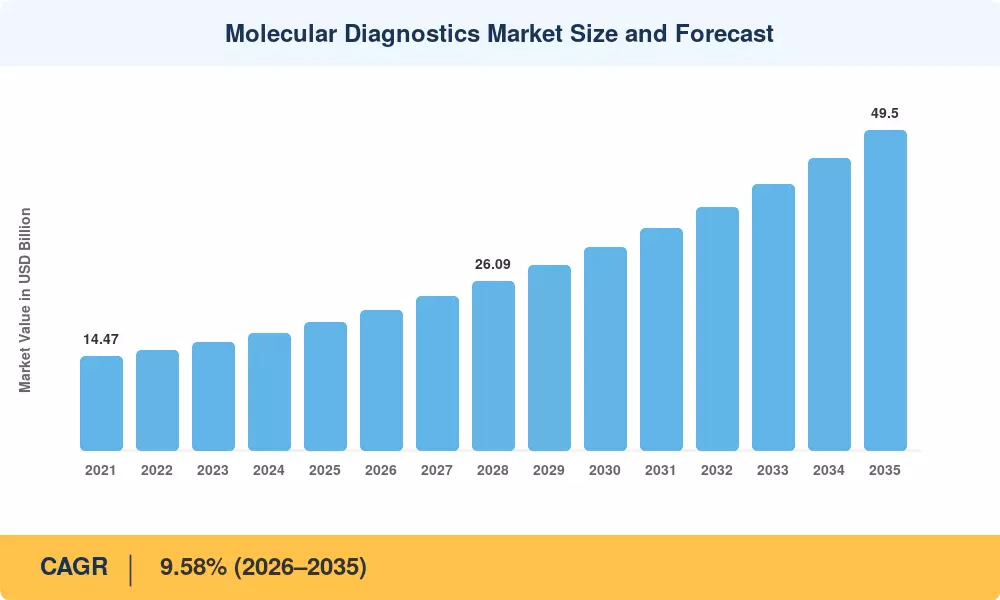
Molecular Diagnostics Market Size
Molecular Diagnostics Market to Surge from $ 21.72 Bn in 2026 to $ 49.50 Bn by 2035—By Expanding Payer Reimbursement for Genomic Profiling
NY, CA, UNITED STATES, August 11, 2026 /EINPresswire.com/ -- As per Market Research Future, the global Molecular Diagnostics Market size to reach USD 49.50 Billion by 2035 from USD 21.72 Billion in 2026, at a CAGR of 9.58% during the forecast period 2026–2035. The market base was estimated at USD 19.82 Billion in 2025.The 9.58% CAGR—anchored by structural precision-medicine demand rather than discretionary healthcare spending—is driven by three converging forces: expanding payer reimbursement frameworks for genomic profiling that have pulled molecular testing from the research setting into routine clinical workflows, sustained sequencing cost deflation and platform miniaturization that have made whole-genome sequencing economically viable at population scale, and companion diagnostic regulatory mandates by the FDA and EMA that have converted molecular testing from an elective procedure into a clinical necessity tied to targeted-therapy access.
Request A Free Sample:
https://www.marketresearchfuture.com/sample_request/1171
Key Market Trends & Growth Drivers
Expanding Payer Reimbursement for Genomic Profiling
The single most immediate accelerator for the Molecular Diagnostics Market is the broadening of insurance coverage for genomic profiling. CMS's 2024 National Coverage Determination extended reimbursement for comprehensive genomic profiling to all advanced solid tumors, a decision projected to unlock an additional USD 1.2 Billion in annual test volumes by 2027. Private payers have followed: UnitedHealthcare and Aetna both expanded molecular test coverage lists in 2024, covering over 45 specific assays.
Sequencing Cost Deflation and Platform Miniaturization
As of late 2024, the cost of whole-genome sequencing was less than USD 200 per sample, compared to more than USD 1,000 only five years prior. Applications that were previously unfeasible at scale, such as population-level pharmacogenomic testing and newborn screening, are being made possible by this cost curve. High-throughput genomics is now possible for mid-sized community hospitals without centralized laboratory facilities because of compact benchtop sequencers that can handle up to 48 samples per run.
Companion Diagnostic Regulatory Mandates
Legacy culture-based pathogen identification and single-analyte immunoassays are steadily giving way to multiplex syndromic panels and rapid sequencing platforms. The FDA approved 27 new companion diagnostic indications in 2024 alone, the highest annual total on record. Each approval effectively creates a captive market for the associated molecular test, linking drug reimbursement to diagnostic utilization.
Multiplex Syndromic Panel Adoption and Antimicrobial Stewardship
CMS's Oncology Care Model and its successor, the Enhancing Oncology Model, tie provider reimbursement to precision-treatment outcomes. European data from the ECDC consortium show that syndromic panels identifying pathogens within 90 minutes enable targeted therapy initiation, reducing broad-spectrum antibiotic use by up to 30% and lowering average antimicrobial costs per patient admission. This economic incentive has driven hospital formulary committees to prioritize preventive multiplex panel protocols, shifting procurement budgets toward the Molecular Diagnostics Market at the expense of reactive culture-based testing spending. Value-based oncology contracts in the United States and European reference pricing for molecular tests have shifted institutional procurement toward early intervention.
Ask for Customization:
https://www.marketresearchfuture.com/ask_for_customize/1171
Market Segment Insights
BY TECHNOLOGY
Polymerase Chain Reaction (PCR): Dominant segment with ~46.27% revenue share in 2025. Reflecting entrenched physician familiarity with PCR protocols. Real-time and digital PCR variants, available across a vast installed instrument base, anchor institutional formularies globally due to their low cost and decades of clinical evidence supporting PCR-based testing for infectious disease and oncology applications. Hospital procurement teams treat it as a default first-line platform, and established reimbursement codes have enabled broad adoption even in cost-sensitive emerging markets.
Next-Generation Sequencing (NGS): Fastest-growing technology segment at 12.49% CAGR (2026–2035). Driven by new comprehensive genomic profiling approvals and expanding oncology panel indications. Illumina's NovaSeq X and MGI's DNBSEQ-T20 have pushed per-genome costs below USD 200, and pipeline expanded oncology panels targeting multi-cancer early detection could double the segment's addressable population by 2030. The convergence of diagnostic sequencing with matched therapeutic companion diagnostics is creating theranostic platforms that personalize oncology treatment at scale.
BY APPLICATION
Infectious Disease Testing: Dominant application with ~64.21% revenue share in 2025. Approximately 70% of hospital emergency departments now deploy multiplex respiratory panels, making syndromic molecular testing a near-universal component of their care pathway. The inherent demand for rapid pathogen identification in respiratory, sexually transmitted infection, and blood-safety screening programs drives sustained dual-channel demand for molecular diagnostics.
Oncology: Fastest-growing application segment at 10.93% CAGR (2026–2035). Reflecting companion diagnostic mandates and liquid biopsy expansion that extend the window for precision oncology testing. Immune checkpoint inhibitor companion diagnostic requirements create a larger prevalent population requiring sustained molecular profiling.
BY PRODUCT TYPE
Reagents & Kits: Dominant segment with ~72.0% revenue share in 2025. Hospital and laboratory procurement teams treat reagent consumables as a default recurring revenue model, and the razor-and-blade business model has enabled broad adoption even in cost-sensitive emerging markets.
Instruments & Systems: Fastest-growing product segment at 12.53% CAGR (2026–2035). Platform refresh cycles and point-of-care device adoption drive demand. Compact benchtop sequencers and CLIA-waived molecular platforms enable high-throughput genomics in mid-sized community hospitals without centralized laboratory facilities.
BY SAMPLE TYPE
Blood, Serum & Plasma: Dominant sample type with ~86.15% revenue share in 2025. Liquid biopsy adoption and blood-safety screening programs dominate volume. Blood-based molecular testing delivered in hospital outpatient and reference laboratory settings anchor this segment.
Urine: Fastest-growing sample type segment at 12.20% CAGR (2026–2035). Convenience and STI molecular testing drive demand. Urine-based molecular assays reduce collection complexity and enable testing in community clinics lacking phlebotomy infrastructure.
BY END USER
Diagnostic & Reference Laboratories: Largest segment with ~24.64% share in 2025. Comprehensive high-complexity testing centralization and companion diagnostic administration requirements dominate volume. Reference laboratories remain the primary delivery site for next-generation sequencing and complex molecular profiling due to specialized bioinformatics infrastructure, quality control accreditation, and CLIA certification requirements.
Clinics & Ambulatory Care: Fastest-growing end-user segment at 11.13% CAGR (2026–2035). Outpatient shift and decentralized testing drive demand as point-of-care molecular assays reduce the need for centralized laboratory infrastructure. Community clinics and retail health settings increasingly prescribe rapid molecular testing options to manage reference laboratory capacity.
Read Detailed Insights:
https://www.marketresearchfuture.com/reports/molecular-diagnostics-market-1171
Regional Outlook
North America — Dominant Market (~45.50% Share, 2025)
The United States generates approximately 83.6% of North American Molecular Diagnostics Market revenue, driven by CMS genomic profiling coverage mandates, commercial insurance reimbursement for comprehensive genomic profiling and companion diagnostics as first-line molecular testing, and broad reimbursement for PCR-based syndromic panel regimens—a single policy ecosystem that converted a research-dominated market into one with a structural precision-medicine tail.
CMS reimbursement for molecular tests under the Clinical Laboratory Fee Schedule has driven adoption in academic medical centers, while community oncology networks increasingly prescribe point-of-care molecular testing options to manage reference laboratory capacity. The US dominates through a combination of high per-patient spending, robust payer coverage, and rapid next-generation sequencing adoption.
Europe — Second Largest (USD 5.35 Billion, 2025)
Europe's Molecular Diagnostics Market reflects divergent national strategies—Germany leads regionally with hospital laboratory automation and IVDR early compliance, contributing 24.3% of regional share, while the UK historically used selective molecular testing targeting before broadening coverage through NHS Genomic Medicine Service expansion at 9.87% CAGR. France contributes ~USD 0.72 Billion through Plan France Médecine Génomique 2025. Italy contributes 8.95% CAGR on oncology companion diagnostic adoption in tertiary centers. Spain is growing at steady pace on national TB/STI molecular screening programs.
Asia-Pacific — Fastest-Growing Region (12.21% CAGR, 2026–2035)
Asia-Pacific is the engine of the Molecular Diagnostics Market. China holds the largest regional share with ~38.7% of regional revenue, driven by Healthy China 2030 and domestic sequencer manufacturing that has reduced instrument costs by 40% relative to Western imports—instantly extending molecular diagnostics coverage to over 1.3 billion insured lives. India is growing at 13.58% CAGR on the back of Ayushman Bharat screening and National TB Elimination Programme expansion. Japan contributes USD 0.68 Billion through NHI pricing for pharmacogenomics in polypharmacy at steady pace. South Korea is growing at 11.24% CAGR on precision medicine cohort programs.
Middle East & Africa — Emerging Opportunity (8.74% CAGR, 2026–2035)
The Middle East & Africa is bifurcated between well-funded Gulf states and resource-constrained Sub-Saharan nations. Saudi Arabia leads the region with Vision 2030 healthcare modernization, contributing ~31.4% of regional share—SAR 3.5 Billion earmarked for genomic medicine infrastructure, including a national genome project that will sequence 100,000 Saudi genomes by 2030. The UAE is growing at 10.35% CAGR on Dubai and Abu Dhabi genomic medicine centers. South Africa contributes USD 0.11 Billion on National Health Laboratory Service TB and HIV programs.
South America — Growing Presence (USD 0.99 Billion, 2025)
Brazil anchors South America's Molecular Diagnostics Market at ~58.2% of regional revenue, with the Unified Health System (SUS) allocating BRL 1.4 Billion for public-health laboratory modernization through 2028, including molecular testing equipment for HIV viral-load monitoring and tuberculosis drug-resistance screening, providing a stable demand floor that smooths regional forecasts. Access to next-generation sequencing remains limited by reagent import dependencies, though the Brazilian National Cancer Institute has initiated domestic genomic profiling feasibility studies. Argentina is growing at 9.15% CAGR on private oncology clinic expansion.
Competitive Landscape and Recent Developments
The Molecular Diagnostics Market displays medium concentration, with the top five companies holding an estimated 52–58% combined revenue share. The Herfindahl-Hirschman Index sits in the 1,200–1,500 range, reflecting a mix of multinational platform leaders and specialized assay developers. Recent M&A activity—including Danaher's integration of Cepheid and Roche's acquisition of GenMark—has further tightened competitive dynamics, though pipeline innovation in next-generation sequencing and liquid biopsy sustains competitive moats for first-movers.
The competitive landscape is stratified between PCR platform pioneers serving global infectious disease testing markets, next-generation sequencing specialists capturing oncology companion diagnostic tenders, and point-of-care developers consolidating the decentralized testing segment.
KEY COMPANIES AND RECENT MILESTONES
Roche Diagnostics (2024–2025): Maintains leadership with cobas PCR systems and AVENIO ctDNA panels, commanding ~14–17% of global Molecular Diagnostics Market revenue. Full-spectrum platform leader with pharma-diagnostics integration. Premium platform positioning in specialty segments offsets price compression in competitive markets.
Abbott Laboratories (2024–2025): Alinity m and ID NOW rapid molecular platforms reinforce the point-of-care-to-centralized lab portfolio positioning, holding ~9–12% of global revenue. The company benefits from the structural point-of-care tail created by expanded CLIA-waived testing mandates.
Danaher (Cepheid) (2024–2025): GeneXpert systems and Xpert syndromic panels reinforce the point-of-care dominance and CLIA-waived leadership positioning, holding ~8–11% of global revenue.
Hologic Inc. (2024–2025): Panther system and Aptima assays reinforce the women's health molecular and STI panel strength positioning, holding ~6–9% of global revenue.
bioMérieux (November 2023): Expanded the BioFire FilmArray panel menu to include a 27-target lower-respiratory infection panel, securing CE-IVDR marking ahead of regulatory deadlines. Syndromic panel pioneer and antimicrobial stewardship leader, holding ~5–8% of global revenue.
Future Outlook: 2026–2035
By 2030, precision molecular theranostics will become the operating system of oncology and infectious disease management. The convergence of companion diagnostics and targeted sequencing will reshape the Molecular Diagnostics Market through the late 2020s. By 2030, an estimated 40% of newly diagnosed metastatic cancer patients will undergo comprehensive genomic profiling followed by matched targeted therapy, creating a diagnostic-therapeutic revenue loop.
The FDA's 27 companion diagnostic approvals in 2024 ensure that molecular test demand scales alongside clinical adoption. Machine-learning models that integrate genomic, proteomic, and imaging biomarkers can recommend optimal sequencing of PCR, NGS, and liquid biopsy platforms for individual patients. Start-ups have raised over USD 800 million in venture funding for oncology decision-support tools since 2023.
Point-of-care expansion and AI-integrated clinical decision support will reframe cost structures by the early 2030s. The global point-of-care molecular testing segment is projected to surpass USD 6 Billion by 2032, driven by retail-clinic deployments in North America and community health worker programs in sub-Saharan Africa. While this compresses per-unit revenue for centralized laboratory testing, volume expansion—particularly in Asia-Pacific and South America—is projected to more than offset pricing headwinds.
More Related Research Insights:
https://www.marketresearchfuture.com/reports/endoscopy-devices-market-1967
https://www.marketresearchfuture.com/reports/closed-system-drug-transfer-device-market-7733
https://www.marketresearchfuture.com/reports/microscopy-devices-market-2313
https://www.marketresearchfuture.com/reports/biosensor-market-1228
https://www.marketresearchfuture.com/reports/bispecific-antibodies-market-21846
https://www.marketresearchfuture.com/reports/laboratory-equipment-market-8365
https://www.marketresearchfuture.com/reports/medical-device-connectivity-market-6041
https://www.marketresearchfuture.com/reports/respiratory-care-devices-market-6517
https://www.marketresearchfuture.com/reports/ai-drug-discovery-market-9393
https://www.marketresearchfuture.com/reports/hernia-repair-market-2287
Larry Wilson
WantStats Research And Media Pvt. Ltd.
+1 855-661-4441
email us here
Visit us on social media:
LinkedIn
Facebook
YouTube
X
Legal Disclaimer:
EIN Presswire provides this news content "as is" without warranty of any kind. We do not accept any responsibility or liability for the accuracy, content, images, videos, licenses, completeness, legality, or reliability of the information contained in this article. If you have any complaints or copyright issues related to this article, kindly contact the author above.
