

Animal Stem Cell Therapy Market to reach USD 507.90 Million by 2035 at 5.80% CAGR
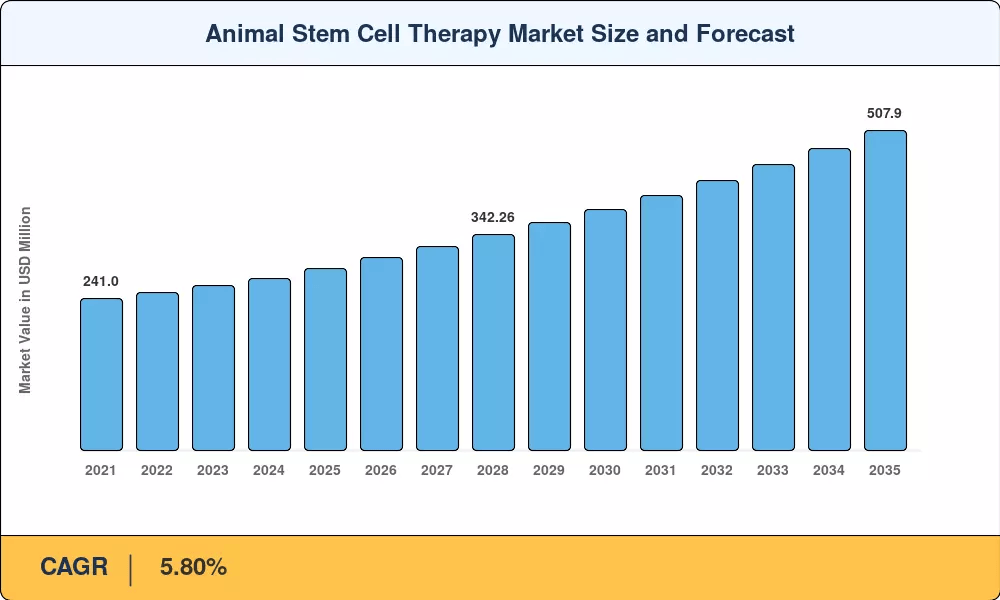
Animal Stem Cell Therapy Market Size
Animal Stem Cell Therapy Market to Surge from USD 305.76 Mn in 2026 to USD 507.90 Mn by 2035-By Rising Chronic Musculoskeletal Conditions in Companion Animals
NY, CA, UNITED STATES, June 16, 2026 /EINPresswire.com/ -- As per Market Research Future, the global Animal Stem Cell Therapy Market size to reach USD 507.90 Million by 2035 from USD 305.76 Million in 2026, at a CAGR of 5.80% during the forecast period 2026--2035. The market base was estimated at USD 289.00 Million in 2025.The 5.80% CAGR---anchored by structural veterinary care demand rather than discretionary healthcare spending---is driven by three converging forces: rising prevalence of chronic musculoskeletal conditions in companion animals that continue to widen the addressable patient base for animal orthopedic cell treatment, sustained regulatory pathway modernization exemplified by the USDA's streamlined licensing pathway for autologous stem cell products that has converted veterinary regenerative medicine from an experimental niche into a commercially viable category, and the expanding global pet ownership and humanization trend that has elevated willingness to pay for pet stem cell treatment among millennial and Gen-Z pet owners who view companion animals as family members.
National governments and multilateral health organizations are amplifying this momentum. Osteoarthritis alone accounts for roughly 80% of lameness cases in dogs and cats, with obesity rates rising and lifespans extending in companion animal populations. The USDA's Center for Veterinary Biologics has fast-tracked several autologous cell therapy licensing pathways since 2023, reducing average approval timelines by an estimated 14 months.
The European Medicines Agency issued updated guidance on advanced therapy veterinary medicinal products (ATVMPs) valued at over EUR 12 million in compliance investment across the EU. Japan's Ministry of Agriculture, Forestry and Fisheries introduced a conditional approval category for veterinary cell therapies in 2024, opening Asia-Pacific's second-largest companion animal market to commercial-scale stem cell treatments.
Data from the 2024 Shelter Animal Count report showed approximately 3.1 million dogs and cats entering U.S. shelters in the first half of 2024 alone. Together, these initiatives are creating the procurement infrastructure and delivery innovation on which the Animal Stem Cell Therapy Market depends.
Request A Free Sample:
https://www.marketresearchfuture.com/sample_request/35924
Key Market Trends & Growth Drivers
Rising Chronic Disease Prevalence in Companion Animals
Osteoarthritis remains the single largest clinical driver of the animal stem cell therapy market. A 2024 analysis by Companion Animal Health confirmed that OA accounts for at least 80% of lameness and joint disease presentations in dogs and cats, a proportion that has climbed steadily as obesity rates rise and lifespans extend in companion animal populations. Chronic kidney disease adds further urgency---a retrospective study published in the International Journal of Veterinary Science and Animal Husbandry (October 2024) documented a 2.64% CKD incidence rate across 2,456 dogs examined, with male dogs disproportionately affected at 70.77%.
These epidemiological trends directly expand the addressable patient population for animal orthopedic cell treatment and renal regenerative protocols alike. Each percentage point of disease prevalence gain translates into measurable procedure volume, and the pet stem cell treatment schedule embedded in routine veterinary care makes this driver structurally durable through 2035.
Regulatory Pathway Modernization for Veterinary Biologics
Regulatory frameworks are evolving to accommodate the unique characteristics of cell-based veterinary products. The USDA Center for Veterinary Biologics streamlined its licensing pathway for autologous stem cell products in 2023, reducing average approval timelines by an estimated 14 months. Across the Atlantic, the EMA's Committee for Veterinary Medicinal Products finalized updated ATVMP guidance in early 2024, creating a clearer route-to-market for allogeneic products across all 27 EU member states. Japan's Ministry of Agriculture, Forestry and Fisheries introduced a conditional approval category for veterinary cell therapies in 2024, opening Asia-Pacific's second-largest companion animal market to commercial-scale stem cell treatments. These catalysts are reshaping how capital flows into companion animal cell therapy research pipelines.
Expanding Global Pet Ownership and Humanization Trend
The global pet population continues to grow at a pace that directly translates into demand for advanced veterinary regenerative medicine. Data from the 2024 Shelter Animal Count report showed approximately 3.1 million dogs and cats entering U.S. shelters in the first half of 2024 alone. Pet humanization---the tendency of owners to seek human-grade medical care for animals---has elevated willingness to pay for pet stem cell treatment, particularly among millennial and Gen-Z pet owners who view companion animals as family members. In Western Europe, average annual veterinary expenditure per pet exceeded EUR 500 in 2024, a figure that correlates directly with the adoption of premium therapies, including companion animal cell therapy.
Ask for Customization:
https://www.marketresearchfuture.com/ask_for_customize/35924
Market Segment Insights
BY TYPE
Autologous Stem Cell Therapy: Dominant segment with ~58% revenue share in 2025. Reflecting lower immunological rejection risk and established clinical protocols in veterinary regenerative medicine. The autologous approach---harvesting adipose or bone marrow tissue from the patient animal, processing it, and re-injecting---benefits from a strong safety profile and two decades of clinical familiarity among veterinary surgeons. VetStem Biopharma alone has facilitated over 20,000 autologous procedures since its founding, primarily for canine and equine patients with musculoskeletal conditions.
Allogeneic Stem Cell Therapy: Fastest-growing type segment at 6.90% CAGR (2026--2035). Off-the-shelf convenience appeals to high-volume veterinary clinics seeking scalable pet stem cell treatment options. Allogeneic MSCs from healthy, young donor animals can be banked, quality controlled and transported as needed, an operational model that parallels the companion animal cell therapy workflow doctors now use for blood product infusions.
Induced Pluripotent Stem Cell Therapy: Emerging segment; early veterinary trials underway. Gene-modified stem cells designed to express anti-inflammatory cytokines at injury sites represent a longer-horizon opportunity that could redefine the therapeutic ceiling of veterinary regenerative medicine by the early 2030s.
BY APPLICATION
Osteoarthritis: Dominant application with ~34% revenue share in 2025. Reflecting the condition's outsized prevalence in aging companion animal populations. The condition affects an estimated 20% of dogs over age one and up to 90% of cats over age 12 in North America, creating a massive addressable patient pool for animal orthopedic cell treatment.
Tendonitis: Fastest-growing application segment in the equine stem cell therapy segment, particularly in North America and Western Europe, where sport-horse expenditure remains high. Thoroughbred and warmblood horses with superficial digital flexor tendon injuries have shown 80% return-to-performance rates following MSC treatment, compared with 50--60% under conventional management. USD 38.50 Million in 2025.
BY ANIMAL TYPE
Companion Animals (Dogs, Cats, Horses): Dominant segment with ~72% revenue share in 2025. Driven by pet humanization and owner willingness to pay for advanced veterinary care. Dogs represent the single largest species-level demand driver, reflecting both population size and clinical evidence depth for companion animal cell therapy in osteoarthritis, tendonitis, and inflammatory conditions.
Livestock Animals: Fastest-growing animal type segment at 6.5% CAGR (2026--2035). High-value breeding animal applications drive demand, with interest concentrated in high-value dairy cattle and breeding bulls where the economic return on advanced veterinary regenerative medicine can justify treatment costs exceeding USD 3,000 per animal.
BY END USER
Veterinary Hospitals: Largest segment at ~48% share in 2025. Specialized infrastructure and equipment dominate volume, channeling routine veterinary regenerative medicine supply. Veterinary hospitals command the largest end-user share, leveraging their surgical suites, anesthesia capabilities, and specialist staff to deliver complex pet stem cell treatment protocols.
Research Institutes: Fastest-growing end-user segment at 7.1% CAGR (2026--2035). Academic pipeline and clinical trials drive demand for companion animal cell therapy research. Research institutes, while a smaller revenue contributor, play a critical role in generating the clinical evidence that drives commercial adoption of veterinary regenerative medicine.
Read Detailed Insights:
https://www.marketresearchfuture.com/reports/animal-stem-cell-therapy-market-35924
Regional Outlook
North America -- Dominant Market (~38% Share, 2025)
The United States generates approximately 78% of North American Animal Stem Cell Therapy Market revenue, driven by the largest companion animal population, high pet insurance penetration, and a dense network of specialty veterinary hospitals---a single policy ecosystem that converted an experimental niche into one with a structural regenerative medicine tail. The USDA's 2023 streamlined licensing pathway has directly accelerated the commercialization timeline for both autologous and allogeneic veterinary regenerative medicine products. The US dominates through a combination of 65 million pet-owning households, the world's highest per-capita veterinary expenditure, and rapid adoption of novel cell processing technologies.
Europe -- Second Largest (~27% Share, 2025)
Europe's Animal Stem Cell Therapy Market reflects divergent national strategies---Germany leads regionally with leading veterinary research institutions, contributing ~22% of regional share, while the UK historically used selective regenerative medicine targeting before broadening coverage through equine sport-medicine leadership, growing at 6.1% CAGR. France contributes USD 8.90 Million through a strong companion animal welfare framework. Italy is growing at 5.4% CAGR on a growing pet insurance market. Spain contributes USD 5.15 Million on expanding veterinary specialty clinics.
Asia-Pacific -- Fastest-Growing Region (7.2% CAGR, 2026--2035)
Asia-Pacific is the engine of the Animal Stem Cell Therapy Market. China holds the largest regional share with ~35% of regional revenue, driven by an estimated 120 million pet dogs and cats and a veterinary services sector that grew at 18% annually between 2020 and 2024. India is growing at 8.1% CAGR on rising urban pet ownership---the pet care industry crossed USD 3.3 billion in 2024---creating demand for advanced companion animal cell therapy that is currently met by a small number of specialty clinics in Mumbai, Delhi, and Bengaluru. Japan contributes USD 12.40 Million through advanced veterinary technology adoption at steady pace.
Middle East & Africa -- Emerging Opportunity (Steady Growth, 2026--2035)
The Middle East & Africa carries the widest access gap and therefore the steepest opportunity. The UAE leads the region with ~28% of regional share, driven by high-end veterinary clinics and equine sector demand---Dubai and Abu Dhabi host veterinary facilities that rival North American specialty hospitals. Saudi Arabia contributes USD 2.50 Million on premium pet care spending. South Africa is growing at 5.5% CAGR on the largest veterinary infrastructure in Sub-Saharan Africa.
South America -- Growing Presence (USD 20.20 Million, 2025)
Brazil anchors South America's Animal Stem Cell Therapy Market at ~62% of regional revenue, with a population of over 55 million pet dogs---the second-largest pet dog population globally---providing a stable demand floor that smooths regional forecasts. Veterinary regenerative medicine adoption has been concentrated in São Paulo and Rio de Janeiro, where specialty veterinary hospitals increasingly offer autologous pet stem cell treatment for canine osteoarthritis. Argentina is growing at 5.9% CAGR on growing veterinary specialty infrastructure.
Competitive Landscape and Recent Developments
The Animal Stem Cell Therapy Market exhibits medium concentration with an estimated top-five combined share of 35--42%. The Herfindahl-Hirschman Index (HHI) sits in the moderately concentrated range, reflecting a mix of specialized veterinary biotech firms and diversified animal health conglomerates. Barriers to entry are moderate---regulatory approval requirements and clinical validation timelines deter casual entrants, but the absence of dominant platform monopolies leaves room for innovative newcomers with differentiated cell processing technology or novel allogeneic product platforms.
The competitive landscape is stratified between pioneer autologous service providers serving specialty veterinary hospitals, big-pharma-backed allogeneic platform developers capturing multi-channel tenders, and emerging exosome and gene therapy innovators consolidating the next-generation regenerative medicine segment.
KEY COMPANIES AND RECENT MILESTONES
VetStem Biopharma (May 2024): Reported the successful conclusion of the FDA review of its allogeneic off-the-shelf cell treatment product, PrecisePRP Equine, in the United States. This product is intended to provide a concentrated preparation of platelets in plasma derived from horses for intra-articular use in horses. Pioneer in veterinary regenerative medicine with the largest case database---over 20,000 autologous procedures facilitated since founding---commanding ~8--11% of global Animal Stem Cell Therapy Market revenue.
Aratana Therapeutics (Elanco) (2024--2025): Maintains licensed allogeneic T-cell and stem cell platforms, commanding ~6--9% of global revenue. Big-pharma distribution reach via Elanco network benefits from the structural specialty veterinary tail created by expanded pet insurance coverage and referral hospital growth.
MediVet Biologics (2024--2025): Point-of-care stem cell processing kits anchor a strong clinic-friendly companion animal cell therapy model, holding ~5--8% of global revenue. The company benefits from the structural decentralization trend as general veterinary clinics adopt in-house cell processing capabilities.
Future Outlook: 2026--2035
By 2030, precision veterinary medicine and biomarker-guided therapy will become the operating system of animal stem cell therapy. Genomic profiling of donor and recipient animals, combined with biomarker-based patient selection, will allow practitioners to predict which patients are most likely to respond to companion animal cell therapy.
Early studies at Colorado State University have demonstrated that synovial fluid biomarker panels can predict osteoarthritis treatment response with 78% accuracy. By 2030, expect integration of AI-driven diagnostics with veterinary regenerative medicine protocols to become standard in referral-level practices. Machine learning algorithms trained on treatment outcomes will enable personalized dosing and cell-type selection, improving efficacy rates and reducing unnecessary procedures.
More Related Research Insights:
https://www.marketresearchfuture.com/reports/veterinary-medicine-market-844
https://www.marketresearchfuture.com/reports/stem-cell-therapy-market-6422
https://www.marketresearchfuture.com/reports/veterinary-animal-healthcare-market-43759
https://www.marketresearchfuture.com/reports/animal-biotechnology-market-8904
https://www.marketresearchfuture.com/reports/companion-animal-healthcare-market-1168
https://www.marketresearchfuture.com/reports/veterinary-diagnostics-market-21729
https://www.marketresearchfuture.com/reports/animal-genetics-market-7004
Larry Wilson
WantStats Research And Media Pvt. Ltd.
+1 855-661-4441
email us here
Visit us on social media:
LinkedIn
Facebook
YouTube
X
Legal Disclaimer:
EIN Presswire provides this news content "as is" without warranty of any kind. We do not accept any responsibility or liability for the accuracy, content, images, videos, licenses, completeness, legality, or reliability of the information contained in this article. If you have any complaints or copyright issues related to this article, kindly contact the author above.
